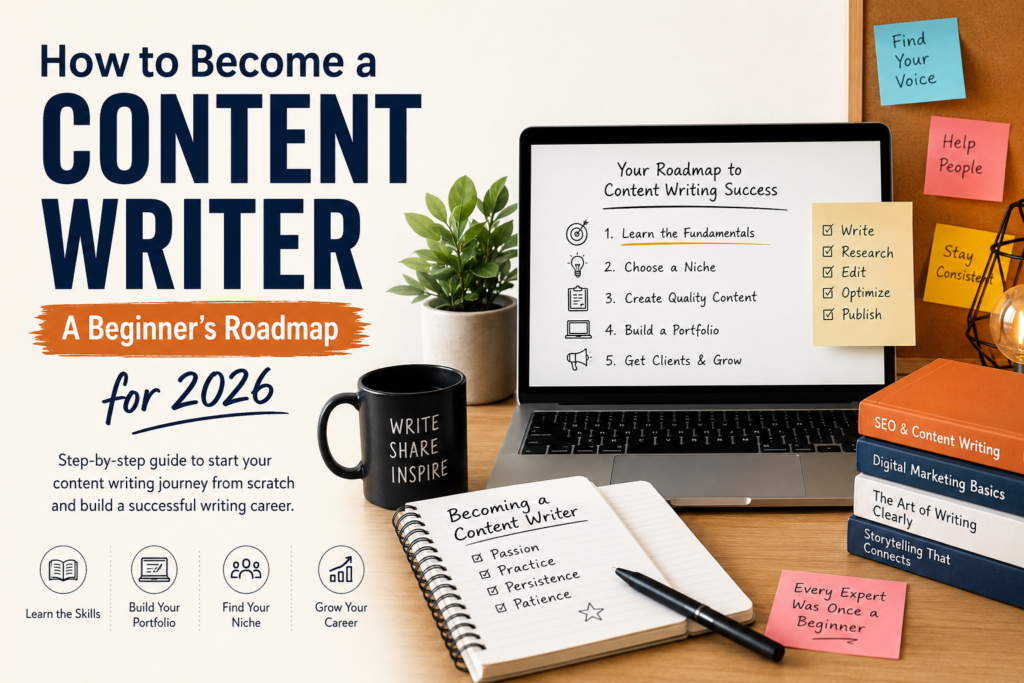
How to Become a Content Writer in 2026: A Beginner’s Roadmap

Quick Answer: How Do You Become a Content Writer in 2026?
To become a content writer in 2026, you do not necessarily need a degree in English, journalism or mass communication. You need the ability to research well. It’s important to understand an audience and explain ideas clearly. You should learn basic SEO. You must edit your own work. Finally, build a portfolio that proves you can write.
Start with a topic you already understand. Create three to five strong writing samples. Learn how search intent and keywords work. Publish your work online. Apply for internships, entry-level content writing jobs or freelance projects. Most importantly, learn to use AI as a tool without allowing it to replace your thinking.
That last part matters more in 2026 than it did a few years ago.
So, You Want to Become a Content Writer?
There was a time when people imagined a writer sitting near a window. The writer had a cup of coffee and waited for inspiration to arrive.
Professional content writing is rarely that romantic.
Some days you will write about a topic you genuinely enjoy. On other days, you find yourself researching an industry you had never heard of until that morning. There will be keywords to understand. You will have deadlines to meet and revisions to make. It will be necessary to verify facts. Clients somehow want a 2,000-word article to be “detailed but short.”
And still, I love writing.
Because content writing has taught me something important: you do not have to start as an expert writer. You can grow into one.
My own academic background was in Computer Science and Engineering. I did not enter the profession through journalism or English literature. Over the years, though, writing led me to technology- and healthcare-related content. It also covered B2B subjects, SEO, real estate, and enterprise topics. Additionally, I explored digital marketing. I also learned about many other subjects, like CRM and ERP. I once knew very little about these areas.
That is one of the reasons I tell beginners not to worry too much about where they are starting from.
Your degree does not have to say content writing.
Your earlier career does not have to include the word “writer”.
Your starting point can actually become your niche.
If you are an engineer, doctor, nurse, commerce graduate, teacher, designer, or lawyer, you have valuable knowledge. Science students and those returning to work after a break also have insights. There is already something you know that businesses need help explaining.
The real question is not:
“Am I qualified to become a content writer?”
It is:
“Can I learn to turn what I know into something another person wants to read?”
That is where the career begins.
What Does a Content Writer Actually Do?
A content writer creates useful written material for a particular audience and business purpose.
That means writing a blog that answers a Google search query. It involves creating a SaaS article that explains software. You can write a healthcare page describing a treatment or a real estate guide for homebuyers. It can also be an email campaign, a landing page, an ebook, a LinkedIn article, or website copy.
Good content thus sits at the intersection of four skills:
writing + research + audience understanding + business thinking.
This is the part beginners often miss.
Beautiful English alone will not make you a strong commercial writer.
A content writer must understand why a piece is being written. They need to know who will read it. Additionally, they must decide what that reader should understand or do after reading it.
Do You Need a Content Writing Degree?
No specific degree is compulsory.
Current career guides from major employment platforms recognize that people enter content writing from a variety of educational backgrounds. They also acknowledge that practical experience and portfolios can play an important role.
In fact, specialised academic knowledge can give you an advantage.
A biotechnology graduate understands scientific terminology faster than a generalist writer. A commerce graduate finds financial subjects easier. A software developer understands APIs and SaaS products. A civil engineer understands construction and property topics.
Do not throw away your old qualification when you become a writer.
Use it.
Choose a Content Writing Niche That Gives You an Advantage
You do not have to stay in one niche forever. I certainly did not.
But choosing one or two areas when you are beginning makes learning, portfolio building and job hunting considerably easier.
| Niche | Useful Background | What You Could Write |
|---|---|---|
| Medical & Healthcare Writing | Medicine, nursing, pharmacy, biotechnology, life sciences | Patient education, healthcare blogs, hospital content, medical technology, wellness content |
| Finance & FinTech Writing | Commerce, accounting, economics, banking, MBA | Personal finance, banking, investments, fintech products, insurance |
| SaaS & Technology Writing | Engineering, computer science, IT | Product guides, comparison articles, use cases, technical blogs, thought leadership |
| Real Estate Writing | Civil engineering, architecture, marketing, finance | Homebuyer guides, property investment, commercial real estate, local market content |
| Education & EdTech Writing | Teachers, trainers, academics | Course content, educational blogs, learning resources, career guides |
| Legal Writing | Law | Legal explainers, law-firm blogs, compliance content |
| Digital Marketing Writing | Marketing, communications, business | SEO, social media, branding, advertising and marketing strategy |
There is an important caution here.
Healthcare and financial topics can directly affect people’s health or financial stability. Google considers such subjects as Your Money or Your Life (YMYL) topics. It places greater emphasis on signals related to trust, skill, and authority.
A beginner can certainly enter these niches, but accuracy becomes non-negotiable.
If you are not a doctor, do not pretend to be one.
If you are not a financial adviser, do not write personal investment recommendations as though you are.
Research authoritative sources, find your limitations and, where appropriate, have subject-matter experts review the material.
Credibility is part of writing.
1. Learn to Write for Readers Before You Write for Google
SEO is important.
But one of the worst mistakes a beginner can make is learning SEO before learning how humans read.
Readers are impatient.
They skim.
They arrive with questions.
They leave when an introduction takes six paragraphs to say what could have been said in one.
So before obsessing over keywords, learn clarity.
Instead of writing:
“In today’s fast-paced digital landscape, businesses across the globe are increasingly recognizing the undeniable importance of digital transformation.”
Try:
“Digital transformation is no longer limited to large enterprises. Even small businesses now use automation, cloud software and AI to reduce manual work.”
The second version tells me something.
That is what content writing should do.
Simple writing is not inferior writing.
In fact, explaining a complicated idea simply often requires greater understanding than making it sound complicated.
2. Learn Research Before You Learn AI Prompting
Research has probably been one of the most valuable skills throughout my writing career.
Because you will eventually get assignments on topics you do not know.
And that is perfectly normal.
The job of a professional writer is not to magically know everything.
The job is to know how to find, understand, verify and explain information responsibly.
Learn to recognize original sources. Read company documentation. Look for government reports, academic research, credible industry reports, expert commentary and first-party data.
Then compare sources rather than depending on one.
AI can accelerate research, but it should never become your only source of truth.
If an AI tool tells you that a study found 73% of consumers prefer something, ask the most important question a writer can ask:
“Where did that number come from?”
If you can’t find the original source, think carefully before using it.
A writer who verifies information is more valuable than a writer who generates paragraphs quickly.
3. Understand Search Intent and Basic SEO
SEO content writing changed enormously over the years.
Earlier, many writers were trained to place an exact keyword a certain number of times. They also were told to reach a predetermined word count.
That approach is increasingly inadequate.
Google’s current guidance says its systems are designed to reward helpful, reliable, people-first content. It specifically encourages original information and significant coverage. Google values first-hand knowledge and content that adds value beyond what existing search results offer. Google also states that it does not have a preferred word count.
So instead of asking:
“How many times should I use the keyword?”
Ask:
“Why did someone search for this?”
Suppose your keyword is:
how to become a content writer
A beginner searching this probably wants to know:
Do I need a degree?
Can I start without experience?
What should I learn?
Which niche should I choose?
How do I create a portfolio?
Where do I find my first job?
Will AI destroy this career?
How much time will it take?
A useful article answers that entire journey.
That is search intent.
SEO then helps search engines understand the useful content you have already created.
4. Create a Portfolio Before Someone Gives You a Job
This is where many freshers become stuck.
They say:
“Companies want experience, but how do I get experience when nobody hires me?”
You create the evidence yourself.
You do not need a client to write your first article.
Imagine that you studied Computer Science.
Create an article titled:
What Is Cloud Computing? A Beginner’s Guide for Small Businesses
If you studied nursing:
How to Prepare for Your First Health Check-Up: A Patient Checklist
If you studied commerce:
Emergency Fund vs Savings Account: What Is the Difference?
If you want real estate:
What First-Time Homebuyers Should Check Before Booking an Apartment
If you want SaaS:
CRM vs Spreadsheet: When Should a Small Business Upgrade?
Now treat the article exactly as if a client were paying you.
Research it.
Outline it.
Use reliable sources.
Optimize the title.
Write a meta description.
Add internal and external linking suggestions.
Edit it.
Then publish it on your website, LinkedIn, Medium or a portfolio platform.
Three outstanding samples are more useful than fifteen careless ones.
5. Learn the Difference Between Content Writing and Copywriting
These terms are frequently mixed together.
Content generally educates, informs, attracts or nurtures an audience.
Copy is usually more directly connected with persuasion and conversion.
A long article explaining CRM software is primarily content.
The headline and CTA on the CRM company’s pricing page are copy.
Modern writers benefit from learning both.
Even an informational blog needs a strong headline, useful opening and sensible call to action.
And website copy becomes stronger when the writer understands research and customer problems.
Do not worry about becoming a master of everything immediately.
Learn the distinction first.
Then expand.
6. Learn Editing — Because Your First Draft Is Not Your Content
A professional writer is often their own first editor.
After writing, I like to mentally change roles.
The writer asks:
“Does this sound good?”
The editor asks:
“Does this sentence need to exist?”
That second question can save an article.
Remove repetition.
Break long sentences.
Check statistics.
Replace vague statements with specific ones.
Read difficult paragraphs aloud.
Check whether every heading actually delivers what it promises.
And remove what I call decorative intelligence — complicated words added simply to make a sentence sound knowledgeable.
Your reader should notice the idea, not struggle with the vocabulary.
7. Learn WordPress, Search Console and Basic Digital Marketing
A writer who understands where content goes after leaving Google Docs becomes much more useful to a business.
Learn how a blog is uploaded to WordPress.
Understand H1, H2 and H3 headings.
Learn title tags and meta descriptions.
Understand internal links, anchor text, URLs, image alt text and basic on-page SEO.
Then learn how Google Search Console shows impressions, clicks, queries and pages.
You do not need to become a technical SEO specialist.
But you should eventually be able to look at an article six months after publication and ask:
Did anyone find this?
What queries brought them here?
Where is the article ranking?
What can I improve?
That is the point where you begin moving from writer to content professional.
Interestingly, Google expanded Search Console in 2026. This allows creators to also analyse how social and video platform content performs across Google Search surfaces. Services such as Instagram, TikTok, X and YouTube are included. That is another reminder that modern content careers are becoming increasingly cross-platform.
8. Build a Personal Brand Before You Think You Need One
You do not need thousands of followers.
You need evidence that you exist professionally.
Create a proper LinkedIn profile.
Mention your niche.
Publish short posts discussing what you are learning.
Share your articles.
Comment intelligently on posts from professionals in your industry.
Create a simple portfolio page.
If you can, build your own website.
One of the greatest advantages of having your own website is that your work starts accumulating under your name. It does not only accumulate under the companies you work for.
That becomes increasingly valuable as your career grows.
Google itself encourages clear authorship information, including visible bylines and author background. This transparency helps readers understand who created a piece of content. It contributes to building trust.
So do not hide behind the content forever.
Let people know who wrote it.
9. Apply Before You Feel Completely Ready
Your first opportunity may be an internship.
It may be an agency.
It may be a small company.
It may be a freelance assignment.
It may even be someone asking you to rewrite three pages of a website.
Take the opportunity seriously.
The early stage of your career is where you learn things tutorials cannot teach properly: client feedback, deadlines, tone of voice, revisions, content briefs, plagiarism checks, SEO requirements and the occasionally mysterious sentence:
“Can you make it more catchy?”
You will gradually learn how to translate vague feedback into useful revisions.
That itself is a professional skill.
A Practical 30-60-90 Day Content Writing Roadmap
| Period | Focus | Target |
| Days 1–30 | Writing fundamentals, research, grammar, readability and basic SEO | Write at least 3 complete practice articles |
| Days 31–60 | Choose a niche, create a portfolio, learn WordPress and Search Console basics | Publish 3–5 polished portfolio pieces |
| Days 61–90 | LinkedIn networking, applications, internships, freelance pitching and interview practice | Start applying consistently and secure real assignments |
Do not interpret this as a guarantee that everyone gets a job within 90 days.
Careers do not work like recipes.
The purpose of the timeline is to prevent something I see frequently: people spending six months learning content writing without actually writing anything.
Writing is learned through writing.
Start earlier.
What Skills Should a Content Writer Learn in 2026?
If I were beginning again today, I would concentrate on seven areas. These areas are clear writing, research, editing, and SEO. Additionally, I would focus on niche knowledge, analytics, and AI-assisted workflows.
Notice that AI is only one of them.
That is deliberate.
A person who knows ten AI tools but can’t identify a weak argument will struggle.
A writer who understands the audience, subject and business problem can learn a new AI tool very quickly.
Build the difficult skills first.
The Big Question: Will AI Replace Content Writers?
This is probably the question worrying new writers most.
And I understand why.
AI can write a blog introduction in seconds.
It can generate title ideas.
It can create an outline.
It can summarize documents.
It can rewrite a paragraph.
It can produce twenty product descriptions while a human writer is still opening the brief.
Pretending this has not changed the profession would be foolish.
AI has changed content writing.
And yes, some of the easiest, most repetitive content work is becoming automated.
If someone’s entire professional value is:
“Give me a keyword and I will produce 1,000 reasonably grammatical words,”
that person now competes directly with machines that can do it almost instantly.
But that is not the whole profession.
AI still creates a new problem for businesses: enormous amounts of content can now be produced. However, someone must decide which information is correct, useful, and original. They also need to ensure it is legally safe, on-brand, and worth publishing.
That is where the opportunity is moving.
In its 2026 guidance for generative AI features in Search, Google specifically encourages content that is unique and non-generic. This includes first-hand experience and information. The content should go beyond simply recycling what other websites or generative AI systems can easily produce. Google also says established SEO fundamentals stay relevant to AI-powered Search experiences.
That gives writers a very important clue.
Do not compete with AI at producing average words faster.
Compete at producing something AI cannot obtain by itself.
Interview an expert.
Analyze original data.
Use your professional experience.
Test a tool.
Study a real business problem.
Add screenshots.
Explain what went wrong.
Compare alternatives after actually using them.
Challenge an assumption.
Turn five confusing sources into one trustworthy explanation.
Ask the question nobody else in the SERP answered.
That is the future of good content writing.
AI Should Become Your Assistant, Not Your Identity
I use AI differently from the way I would advise a beginner to misuse it.
Do not type:
“Write a 2,000-word SEO article about cybersecurity.”
Then copy, paste and call yourself an AI content writer.
You have learned almost nothing from that process.
Instead, research the topic yourself.
Decide who the audience is.
Develop your angle.
Use AI to brainstorm missing questions, organise research, examine alternative structures, improve clarity or identify weaknesses.
Then fact-check.
Rewrite.
Add expertise.
Add judgement.
Add your voice.
AI should reduce mechanical work so that you can spend more time thinking.
It should not remove thinking from the process.
Google does not prohibit AI-assisted content simply because AI was involved. Its guidance focuses much more heavily on whether content is useful and trustworthy. It also assesses if the content is created for people rather than using automation primarily to manipulate rankings.
That distinction matters.
The Struggles Nobody Tells New Content Writers About
Content writing can be satisfying, but the profession has difficult days.
Sometimes your favourite paragraph gets deleted.
Sometimes you spend two hours researching something that becomes three sentences in the final article.
Sometimes SEO requirements feel as though they are fighting your natural writing voice.
Sometimes different clients give contradictory feedback.
Sometimes an article you are proud of receives almost no traffic while something you wrote quickly performs exceptionally well.
And increasingly, writers may hear:
“Why should we pay this much when AI can write it?”
Do not respond by trying to become cheaper than AI.
That race has no pleasant ending.
Become more valuable.
Learn how content supports leads, search visibility, sales, authority and brand positioning.
Understand strategy.
Learn analytics.
Learn to interview experts.
Learn difficult niches.
Become the writer who can question an inaccurate brief rather than merely complete it.
That is how you move from being paid for words to being paid for judgement.
Can Someone From Any Career Become a Content Writer?
In many cases, yes.
Suppose you have spent five years working as a nurse and want a remote career.
You are not starting from zero.
You may already understand patient concerns, medical terminology, hospital environments and healthcare communication better than a generalist writer.
Your challenge is learning digital writing.
The same principle applies to engineers, teachers, accountants, HR professionals, designers and sales professionals.
When changing careers, ask yourself:
What do I already know that another writer would need months to learn?
Start there.
Your old career may become the shortest bridge into your new one.
Should Beginners Become Freelancers or Take a Full-Time Job?
Both paths can work, but they teach different things.
Freelancing teaches pitching, negotiation, client management and independence.
Working inside an agency or company exposes you to editors, designers, SEO specialists, developers, marketers and structured workflows.
For someone completely new, I generally see enormous value in getting at least some experience working with a team.
You learn how content exists inside a business rather than treating every article as an isolated piece of writing.
Later, those skills make freelancing easier too.
Content Writing in 2026 Is Bigger Than Blogging
Do not build a career around only one deliverable.
Learn blogs first. Then, gradually understand website content and landing pages. Explore email, social content, and thought leadership. Dive into video scripts, case studies, and white papers. Also, focus on product content and AI-search-friendly information architecture.
You do not have to write all of them professionally.
But knowing how they fit together makes you more useful.
The writers who thrive in the coming years may not always carry the simple title Content Writer.
They may become:
Content Strategists.
SEO Content Specialists.
SaaS Writers.
Technical Writers.
UX Writers.
Content Marketers.
Medical Writers.
Thought Leadership Writers.
Content Leads.
Editorial Strategists.
AI Content Editors.
The profession is not disappearing.
It is becoming more demanding.
One Piece of Advice I Wish Every Beginner Would Remember
Do not wait to feel like a writer.
Writers do not receive a certificate one morning announcing that they are finally ready.
You become one quietly.
One article.
One terrible first draft.
One revision.
One rejection.
One client.
One byline.
One article that finally ranks.
One reader who tells you something you wrote helped them.
Then another.
There will always be someone who writes better than you.
There will always be a tool that writes faster than you.
Neither prevents you from building a career.
Your job is to become a little more observant, knowledgeable and useful with every piece you write.
Because ultimately, good content writing has never been about filling a blank page with words.
It is about understanding something well enough to make it clearer for someone else.
AI has not made that ability worthless.
In 2026, it may have made it more important.
Frequently Asked Questions About Becoming a Content Writer
Can I become a content writer with no experience?
Yes. Start by creating your own portfolio samples rather than waiting for a client. Three to five well-researched articles can demonstrate your writing, research and SEO abilities when applying for beginner roles.
Can I become a content writer without an English degree?
Yes. Writers enter the profession from engineering, healthcare, commerce, science, education and many other fields. Domain knowledge can actually become an advantage when choosing a specialised niche.
What qualifications are required for content writing?
There is no universal qualification. Strong writing, research, editing, and SEO knowledge are crucial. Understanding your audience is essential. A credible portfolio is often more important than holding a specific content-writing degree.
Is content writing still a good career after AI?
Yes, but the skill requirements are changing. Basic, generic writing is easier to automate. Writers with subject expertise, research skills, and original insight are better positioned. They also need skills in SEO, editing, strategy, and responsible use of AI for the new market.
Which content writing niches are good for beginners?
Technology, SaaS, healthcare, finance, real estate, education, digital marketing and ecommerce all offer writing opportunities. The best starting niche is often one connected with your education, professional experience or genuine interest.
How do I create a content writing portfolio without clients?
Choose a niche and create realistic sample assignments yourself. Research them thoroughly. Optimise them for search. Edit them professionally. Publish them through your own website, LinkedIn, Medium, or another portfolio platform.
Should content writers learn SEO?
Yes. You do not need to become an SEO specialist. However, understanding search intent, keywords, and headings can significantly improve your value as a digital content writer. Internal links, title tags, meta descriptions, and Search Console are also important.
Should a beginner use ChatGPT or other AI writing tools?
Yes, but use them as assistants rather than substitutes for research and thinking. AI can help with brainstorming, outlines, summarization, and editing. Meanwhile, the writer remains responsible for accuracy. They are also responsible for originality, strategy, and the finished article.
How long does it take to become a content writer?
There is no fixed timeline. A motivated beginner can learn the fundamentals and create a basic portfolio within a few months. However, to become a strong professional writer requires continual practice. It also needs feedback, research, and real-world experience.
How can I get my first content writing job?
Build a focused portfolio. Optimize your LinkedIn profile. Apply for internships and junior content roles. Approach agencies and startups. Network with professionals in your chosen niche. Consider smaller freelance assignments to gain practical experience.
Final Thought
Begin with your current knowledge. You might wonder if you are “qualified enough” to become a content writer. Start with what you already know. Use your existing knowledge as a foundation.
Then learn what you do not.
Write before somebody hires you.
Research before you make claims.
Use SEO without sacrificing your reader.
Use AI without surrendering your mind.
And allow yourself to be a beginner.
Every experienced writer was once staring at that same empty page.